CAARMS for Psychosis
- Prevention of psychosis: rationale and impact.
- Detecting emerging psychosis: key psychopathology and stages of psychosis.
- Overview of psychometric tools used to assess clinical high risk, including the Comprehensive Assessment of At-Risk Mental States (CAARMS), the Structured Interview for Prodromal Syndromes (SIPS), the Scale of Prodromal Symptoms (SOPS), and the DSM-5, with a focus on the CAARMS.
- Comprehensive Assessment of At-Risk Mental States (CAARMS): foundations and core concepts.
- Core subgroups.
- Environmental and practical considerations for assessing clients at risk.
- Thresholds for psychosis, including false positives, false negatives, and outcomes for individuals who do not transition to psychosis.
- At-Risk Mental States (ARMS): attenuated psychotic symptoms, Brief Limited Intermittent Psychotic Symptoms (BLIPS), and Genetic Risk and Deterioration Syndrome (GRDS).
- Core psychometric CAARMS rating principles, including intensity, frequency, onset and offset, relationship to substance use, anchors, 'rate, don't formulate', and functioning.
- Core psychometric CAARMS rating scales: P1 Unusual Thought Content, P2 Non-Bizarre Ideas, P3 Perceptual Abnormalities, and P4 Disorganised Speech.
- Complementary psychometric CAARMS rating scales for affective and behavioural symptoms, including the SOFAS scale.
- Operational and practical considerations for CAARMS assessment in the NHS, including where it fits within wider assessment and risk management, pre-screening, transdiagnostic assessment, and comorbidities.
- Brief overview of clinical care for ARMS, including the principles of screening, assessment, follow-up, crisis management, and preventive interventions.
- Wider context and future directions, including the limited reliability of the CAARMS in adults over 35 years of age and assessing clinical risk states for disorders beyond psychosis.
The eligibility criteria for training will be assessed prior to enrolment on the programme. For practitioner training, Maudsley Learning will ask you to confirm whether you are working in an early intervention for psychosis service, an early detection for psychosis service, general practice, or another clinical service where you may assess young people with emerging mental disorders. For supervisor training, you must have obtained Comprehensive Assessment of At-Risk Mental States (CAARMS) practitioner certification (or pass an initial psychometric reliability test) and demonstrate experience as a senior lead within a specialised clinical service. Scores from each application will determine eligibility for the programme. If you meet the eligibility criteria for supervisor training, please click here for further information.
How is the course structured?
The course is structured into two staged levels of training:
- Practitioner training (2 days)
- Supervisor training (1 day)
- Furthermore, there will be an Annual networking event for all trainees- The National Conference on
Psychosis Prevention
I have no previous certification as a supervisor for CAARMS, however, I have experience with the CAARMS. I would like to apply for the Supervisor course, is this possible?
If you cannot show evidence of CAARMS practitioner certification, you can access the supervisor training by passing a psychometric entry assessment.
Am I eligible for practitioner training?
You are eligible for practitioner training if:
- You are currently working for the NHS in early intervention for psychosis, early detection for
psychosis, general practices, or any other clinical services where you may assess young people with
emerging mental disorders such as psychosis. - You are also eligible if you are a clinician working with people with emerging mental disorders such
as psychosis (e.g., but not restricted to a psychiatrist, mental health nurse, or psychologist) in training.
How much is this course? The course is free for all eligible trainees as it is commissioned, thus fully funded, by Health Education
England (HEE).
Is this training suitable for adult services?
The training is suitable for staff who work with emerging mental health disorders in young people, i.e., individuals aged 12-35.
Is training just focused on early intervention psychosis services or is there scope for it to be available for 24/7 crisis services?
Crisis services are eligible to apply.
Do I gain certification at the end of the CAARMS practitioner course?
Yes. If you pass the final psychometric assessment, you will become a certified CAARMS Practitioner or certified Supervisor. If you do not pass, you will be given a second chance to complete another psychometric assessment within 1 week. If you still do not pass the second test you will need to retake the practitioner
training.
How is the course structured for a Practitioner?
CAARMS practitioners will be empowered over two training days to learn basic skills and core psychometric concepts through frontal lectures, observation, skills practice, supervision and support to upskill and be able to deliver the assessment in clinical care. All trainees will also benefit from an annual networking event to promote sharing of good practices at the end of each training year.
How is the course structured for a Supervisor?
CAARMS supervisors will receive advanced training over one day, with one refresher half day, to effectively supervise, evaluate and assess CAARMS practitioners to build sustainability and impact. All trainees will also benefit from an annual networking event to promote sharing of good practices at the end of each training year.
How do I know I have been accepted onto the course?
Once you have registered your interest or been nominated by your service lead, we will contact all candidates to confirm whether you have successfully gained a place.
Can I attend one day of the practitioner training?
The course layout for the practitioner course consists of 2 days of bespoke training. Both days must be attended in order to pass the final psychometric test and gain practitioner certification.
What is the CAARMS?
The Comprehensive Assessment of At-Risk Mental States (CAARMS) is a semi-structured psychometric instrument for the identification of the At Risk Mental State (ARMS) based on presenting psychopathology. The ARMS could indicate an increased risk of development of first-episode psychosis.
Who can I contact for more information on the CAARMS course?
If you are interested in this training or have any queries, please contact the CAARMS programme delivery
team at CAARMStraining@slam.nhs.uk
I am interested in the CAARMS course, however I am outside England, am I eligible?
Unfortunately, as our training is commissioned by Health Education England, we can only recruit NHS England staff.
I am a psychiatrist in training, am I eligible?
Yes.
I am a GP, am I eligible?
Yes.
How long is the training?
Practitioner training occurs over two back-to-back training days, with an annual event at the end of the year. Supervisor training occurs over a single training day, with a half-day refresher and an annual event.
How do I register my interest in this training?
Please complete the following 2-minute survey in order to register your interest and deem your eligibility:
https://maudsleylearning.qualtrics.com/jfe/form/SV_bBkZ1vl02FmDoKG.
If you have any other queries or wish to submit interest on behalf of a whole team, please contact the CAARMS programme delivery team at CAARMStraining@slam.nhs.uk.
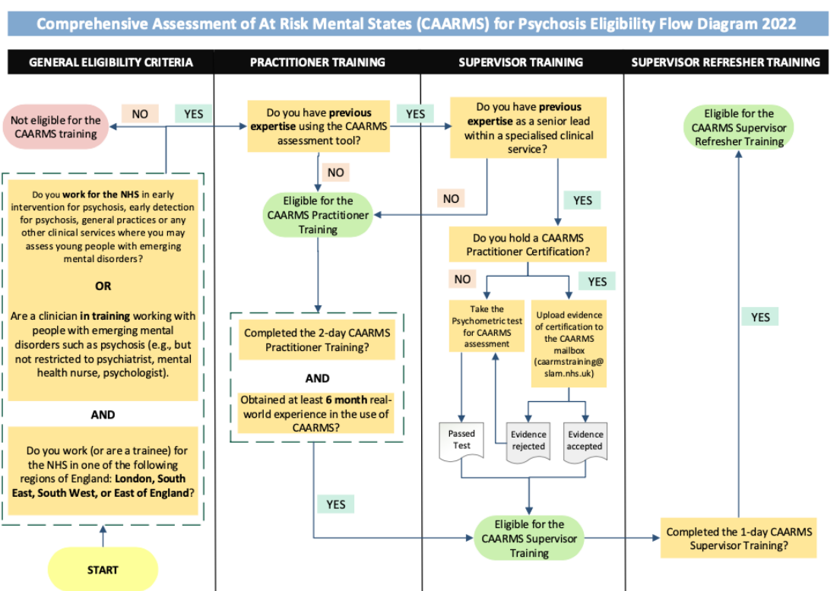
I am unsure whether I am eligible for practitioner or supervisor training, can you help?
Please follow the below eligibility flow diagram to deem eligibility for this training:
Schedule

Group bookings
Discounted rates are available for group bookings. Please contact us for more information. Maudsley Learning has a full range of courses to meet the needs of your organisation. Most can be delivered to you flexibly and tailored to your requirements.

Bespoke courses
We are able to offer custom-made programs, whether digital or face to face, to meet the education and training needs of your organisation in the UK or internationally.

Research
We value research and knowledge-sharing and will continue to contribute to the literature base on mental health education, addressing important research questions in this exciting field.


